BULMA
A Semi-Autonomous Differential Drive Robot

- Year
- 2024
- Role
- Sensor integration and controls
- Skills
- Embedded CCAD
Semi-Autonomous Differential Drive Robot
Overview
Designed and built a semi-autonomous differential-drive mobile robot capable of navigating a game course using closed-loop motor control, absolute position tracking, and onboard sensors.
The robot used an ESP32-S2 microcontroller for control and Wi-Fi communication. An HTC Vive tracking system provided position and orientation data for localization, while wheel encoders enabled PID-based motion control.
Time-of-Flight (ToF) sensors provided additional environmental sensing for wall-following and obstacle detection.
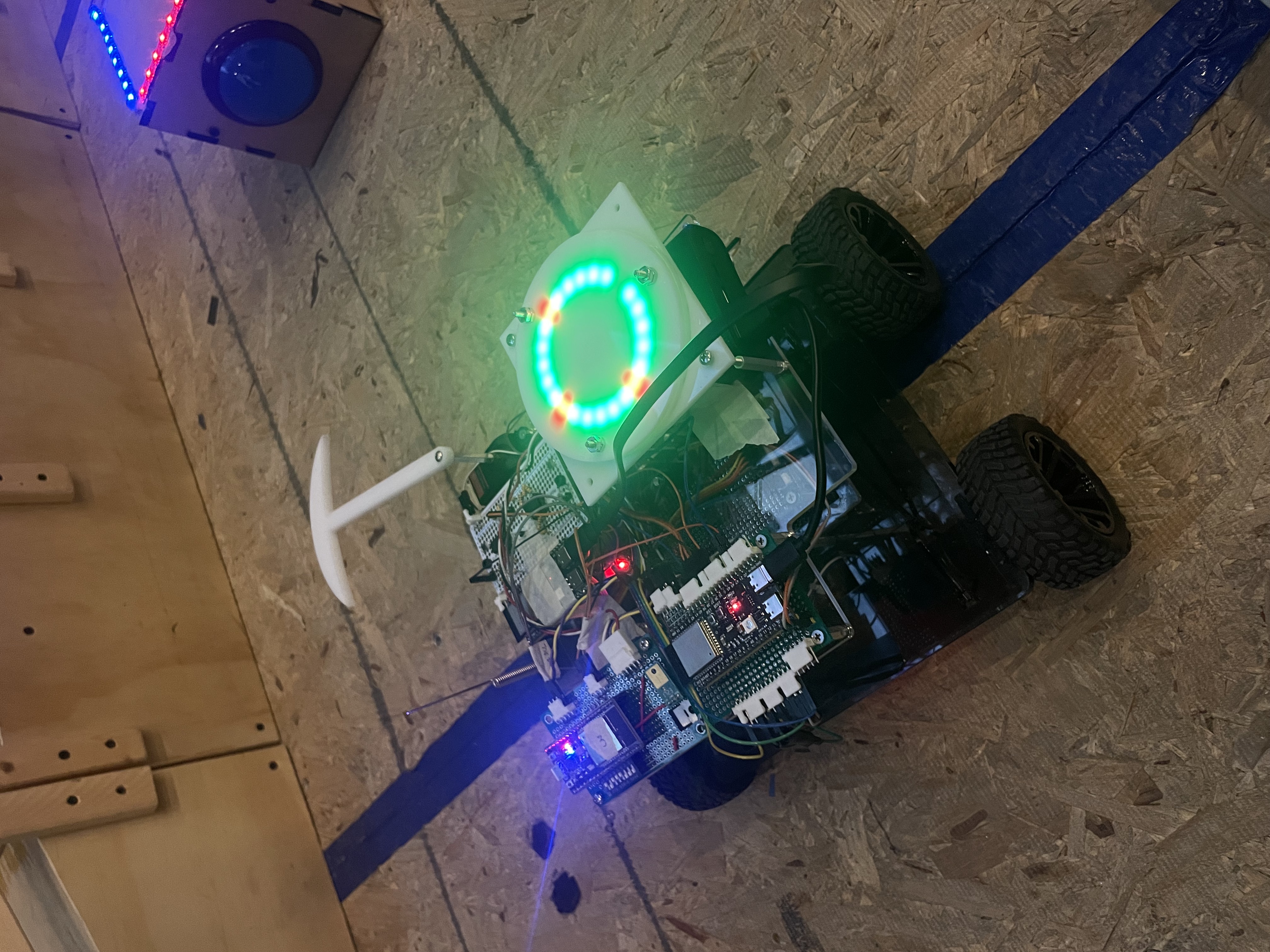
Robot Overview
Full view of the assembled robot.
System Architecture
Hardware
| Component | Function |
| ESP32-S2 | Main controller and Wi-Fi communication |
| HTC Vive Tracker | Absolute XY position and orientation |
| Wheel Encoders | Wheel motion feedback for PID control |
| ToF Sensors | Wall detection and obstacle sensing |
| Differential Drive | Robot locomotion |
| Custom Chassis | Structural support for electronics and drivetrain |
Control and Localization
PID Motor Control
- Implemented closed-loop control using wheel encoder feedback.
- Used PID control to regulate wheel motion and improve navigation accuracy.
HTC Vive Localization
- Used the HTC Vive Lighthouse tracking system for absolute XY localization.
- Obtained position and orientation measurements to support autonomous navigation.
- Integrated localization and sensor feedback into the robot’s control system.
Environmental Sensing
- Integrated Time-of-Flight sensors communicating over the I²C bus.
- Used distance measurements to support wall-following and obstacle detection.
Mechanical Design and Fabrication
Designed and hand-built a custom chassis using a combination of:
- Laser-cut components for the primary structural elements.
- 3D-printed parts for custom mounting and mechanical integration.
The chassis accommodated the differential-drive system, onboard electronics, and sensors.
Key Technical Areas
- Embedded Systems: ESP32-S2 firmware and Wi-Fi communication.
- Control Systems: PID control with wheel encoder feedback.
- Robotics: Differential-drive kinematics and autonomous navigation.
- Localization: HTC Vive Lighthouse position and orientation tracking.
- Sensor Integration: I²C communication with ToF distance sensors.
- Mechanical Fabrication: Laser cutting, 3D printing, and custom assembly.
Project Summary
Developed a semi-autonomous robotic platform combining embedded control, position tracking, distance sensing, and custom mechanical fabrication. The project integrated PID-based wheel control, HTC Vive localization, and ToF environmental sensing to support navigation through a game course.